Fintech
iOS
Consumer Tech
B2B/B2C
Pitch Deck
iOS/Web
Dec 2025 - May 2025
We created a vibrant brand identity for a sustainable portable speaker, blending energy, sophistication, and eco-friendliness. A bold color palette, clean typography, and minimalist photography come together to convey excitement, innovation, and a clean, modern aesthetic.
Applied Skills
0-to-1 Product Development
Mobile Design (iOS)
Web Design
Fintech / Sensitive Data
Consumer Tech
Information Architecture
Interaction Design
User Research
Competitive Analysis
User Journey Mapping
Brand-conscious Design
Visual Design
Design System (from scratch)
High-Fidelity Prototyping
Figma
Systems Thinking
Entrepreneurial Mindset
Stakeholder Alignment
Strategic Leadership
Platform
iOS/Web
Role & Timeline
Dec 2025 - May 2025
Effect
At VidCon sat down with creators, makeup artists, talent managers, and brand reps. One conversation kept coming up: getting paid is a nightmare.
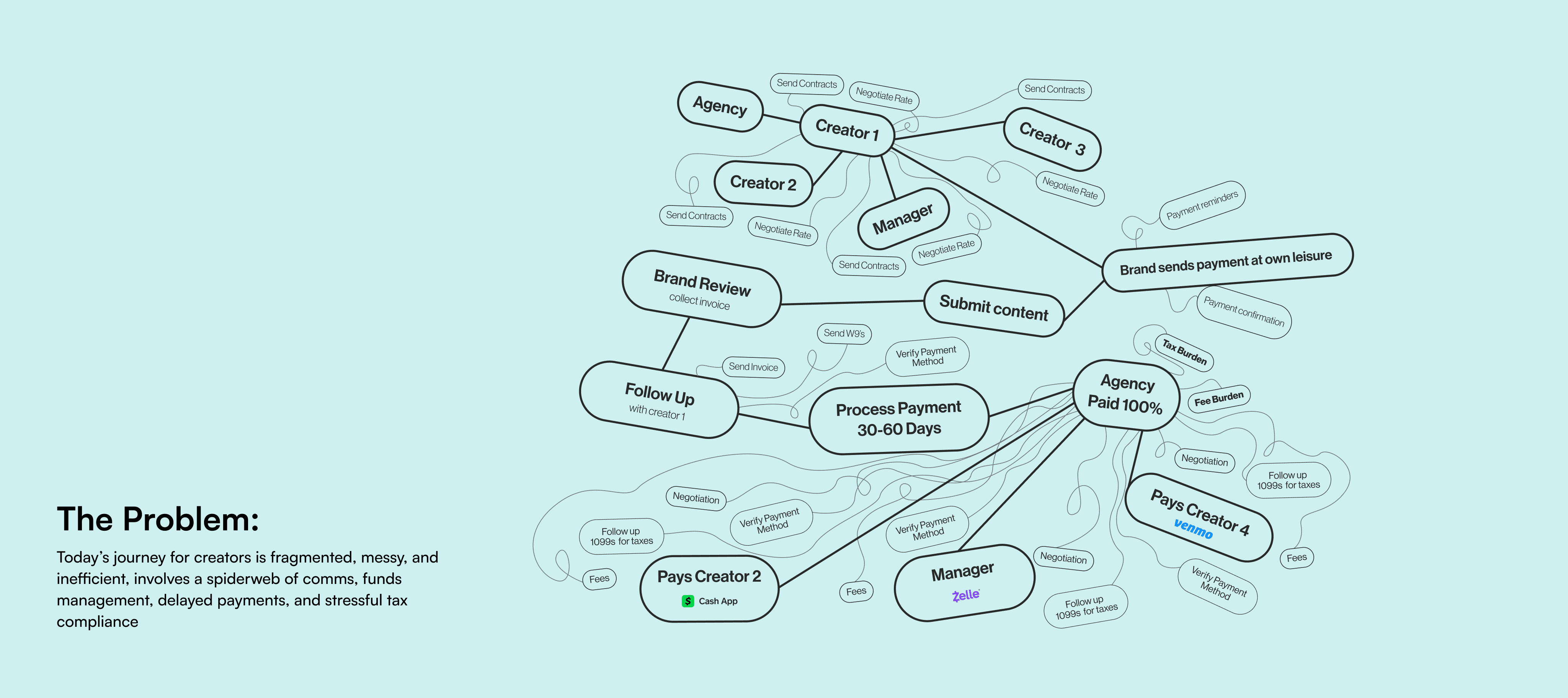
A brand books five creators for a collab shoot. The agency gets paid 30 60 days later. Then they have to split it manually Cash App to one creator, Venmo to another, wire to the international one, Zelle to the manager. Someone's account gets suspended mid-transfer. The creator DMs asking where their money is. The agency sends another invoice. It's been three weeks. This isn't a rare edge case. It's Tuesday for most mid-tier creators.
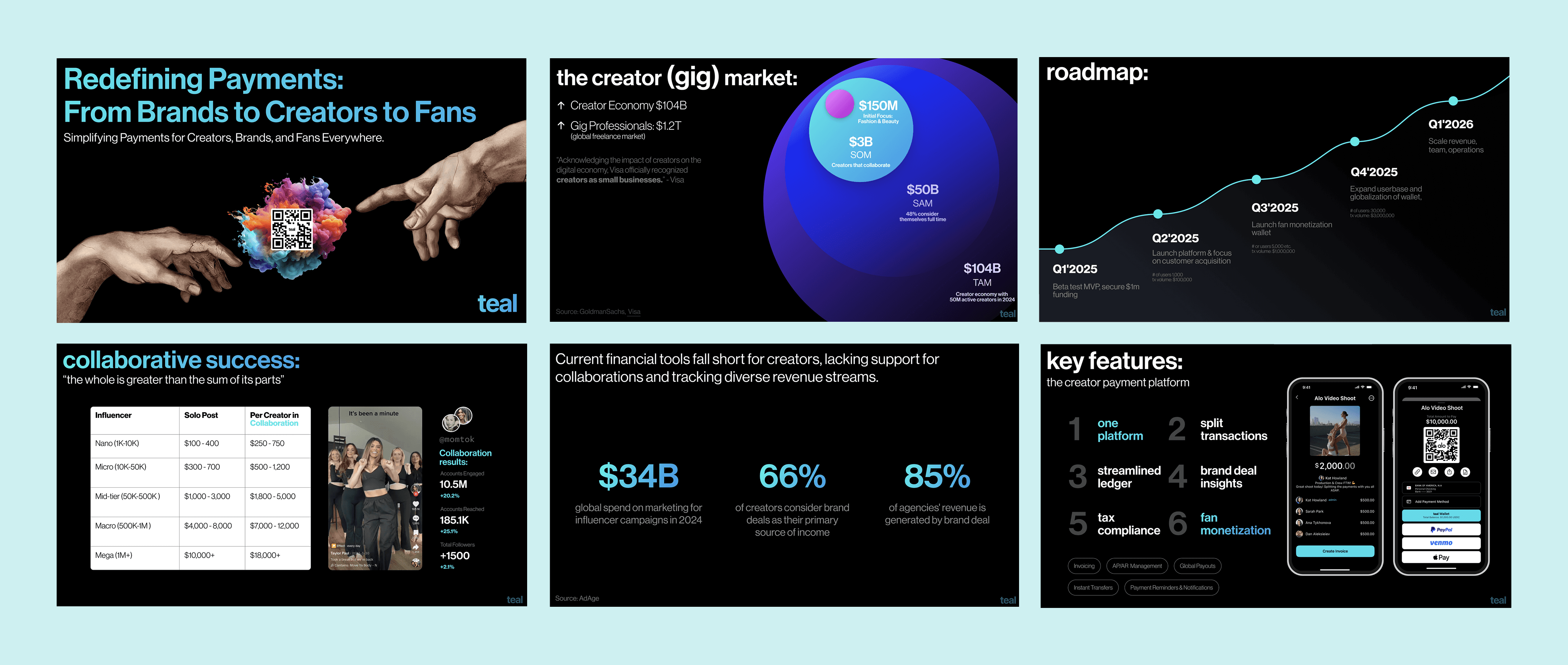
The numbers behind it were staggering. Brands spend $34B globally on influencer campaigns annually. 66% of creators say brand deals are their primary income source. 85% of agency revenue comes from brand deals. And the entire payment infrastructure holding this together is a patchwork of consumer apps that were never built for this.
My fintech background gave me a specific lens on this. Payment rails, split transactions, compliance, tax reporting these are solved problems in traditional finance. Nobody had brought that infrastructure to the creator economy in a way that actually fit how creators work.
Rationable
Before designing anything, I mapped the competitive landscape: Karat, Splitwise, Cash App, PayPal five players across six dimensions: creator focus, collaborative use cases, global payouts, real-time payments, multi-user splits, and stablecoin support.
Teal was the only player with a full score across all six. Nobody else had even attempted the combination of collaborative multi-user payouts with stablecoin rails and built-in tax compliance.
The core design decision was about the payment model. Most fintech apps are built around one sender and one receiver. Creator collabs involve an agency, a manager, multiple creators sometimes international all needing to be paid different amounts, through different methods, at different times. The conventional approach would have been to make everyone download the app. We decided instead that brands didn't need to download anything they'd receive a payment link and choose their preferred method. The split and routing happened on our side.
The stablecoin question was also deliberate. International payments through traditional rails are slow, expensive, and unpredictable. USDC on Bridge (a Stripe company) let us offer instant global payouts at near-zero fees without asking creators to understand crypto. From their side, it just looked like a faster payment.
Operations
Hypotheses: What we Research — two days in LA that became a productset out to prove.
At LA Tech Week I conducted deep-interview sessions with creators, talent managers, and brand-side marketing leads. Three patterns came out of every conversation:
Payments were always late 30 to 60 days was normal, not exceptional. Every person in the chain was chasing somebody else. Tax compliance was terrifying most creators had no W9 system, no 1099 tracking, nothing. And collaboration payments specifically were the worst: five people waiting on one agency, who was waiting on one brand, who sent a Venmo payment that got flagged and suspended.
150 creators signed up to the waitlist before we had a product. That was the validation signal.
Product | Collaborative Use Cases | Global Payments | Real-time payouts | MultiUser Payouts | Stablecoin Benefits | Payment Reminders | |
|---|---|---|---|---|---|---|---|
Karat | No | No | No | No | No | No | |
Splitwise | No | Yes | No | Yes | No | No | |
Cash APP | No | Yes | Yes | No | No | No | |
PayPal | No | Yes | Yes | No | No | No | |
Zelle | No | No | Yes | No | No | No |
Product design defining the system
The Teal ecosystem had four roles: manager/agency (who sets up the collab and splits), brand (who pays), creator (who receives), and international creator (who needed alternative rails). Each role needed a different experience, but a single coherent system underneath.
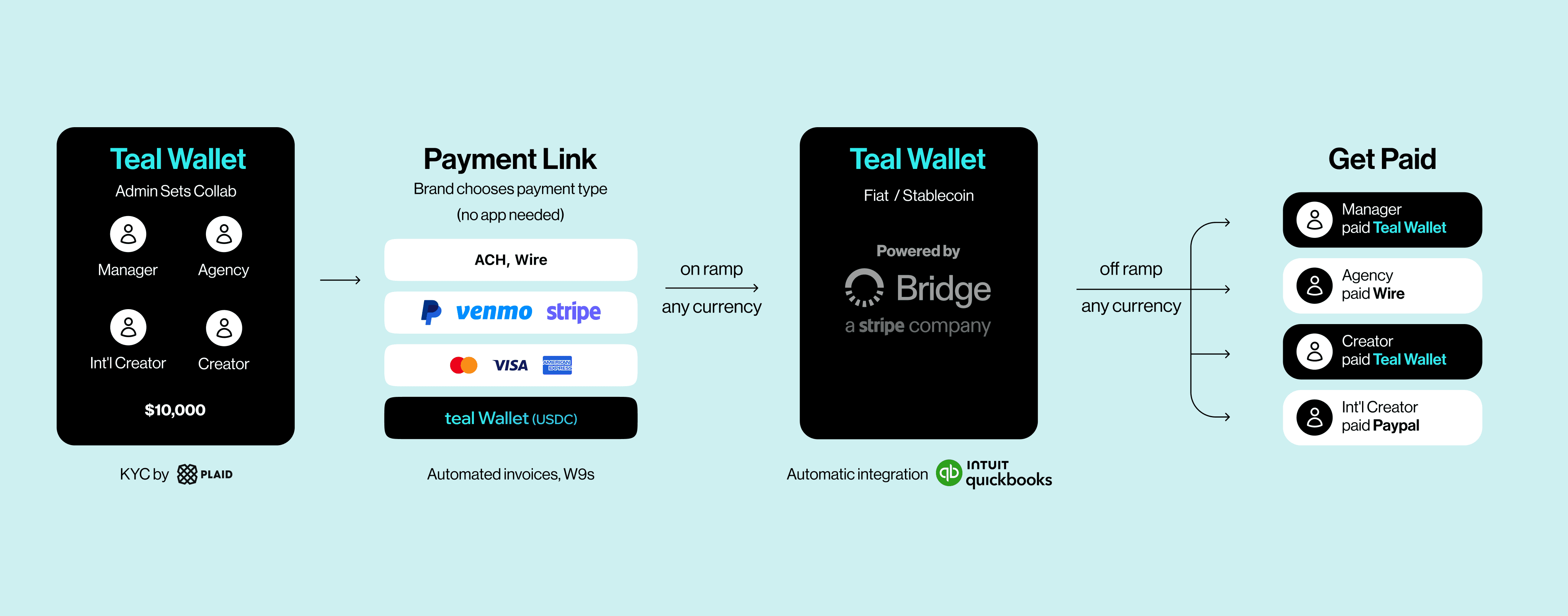
I designed the payment flow as three steps: the Teal Wallet admin sets up the collab and defines splits → a payment link is sent to the brand (no app required) → the brand pays via ACH, wire, Venmo, Stripe, or Teal Wallet → funds route through Bridge to the Teal Wallet → each participant is paid out in their preferred method.
KYC was handled via Plaid. Tax documents W9s, 1099s were automated. QuickBooks integration was built in from day one.
Brand and visual design.
I designed the entire Teal brand from zero. The name, the identity, the color system, the typography, the motion language everything.
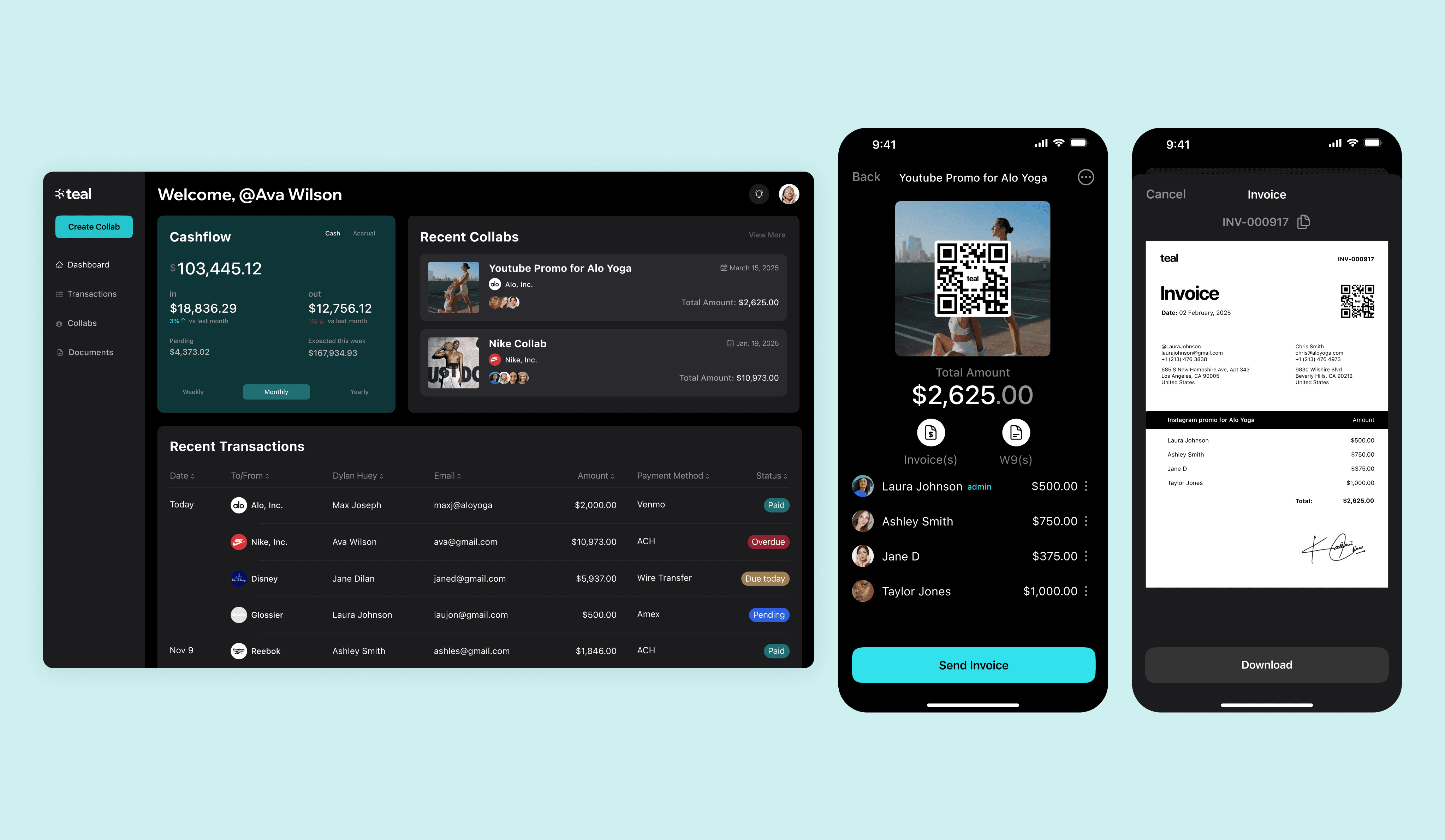
The visual direction was deliberate: dark, premium, creator-native. Not another sterile fintech product with blue gradients and stock photography. The teal accent on black reads like something a creator would actually want to use closer to a creative tool than a bank.
The deck itself was a design artifact not a template with swapped content, but a fully art-directed document that communicated the brand as much as the business. Every slide was designed to carry the same visual weight as the product.
Mobile app and web.
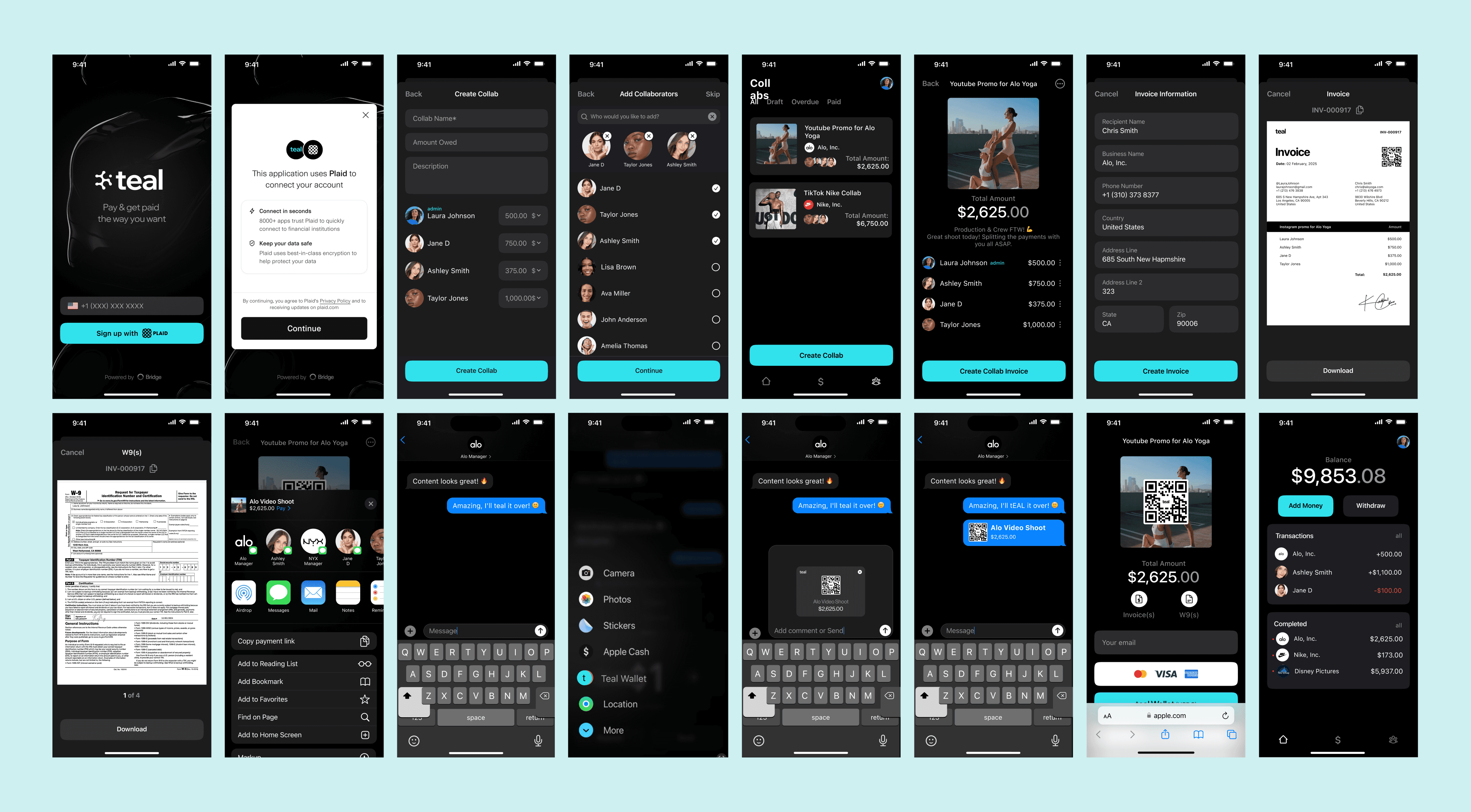
Six features defined the product: one platform for all collab payments, automated split transactions, a streamlined ledger, brand deal insights, built-in tax compliance, and fan monetization.
The mobile app centered on the collab payment flow a creator sees the shoot, their share ($500 of a $2,000 collab with Alo), and can request payment or create an invoice in one tap. The payment screen surfaces all available methods: Teal Wallet, PayPal, Venmo, Apple Pay the brand picks, the split routes automatically.
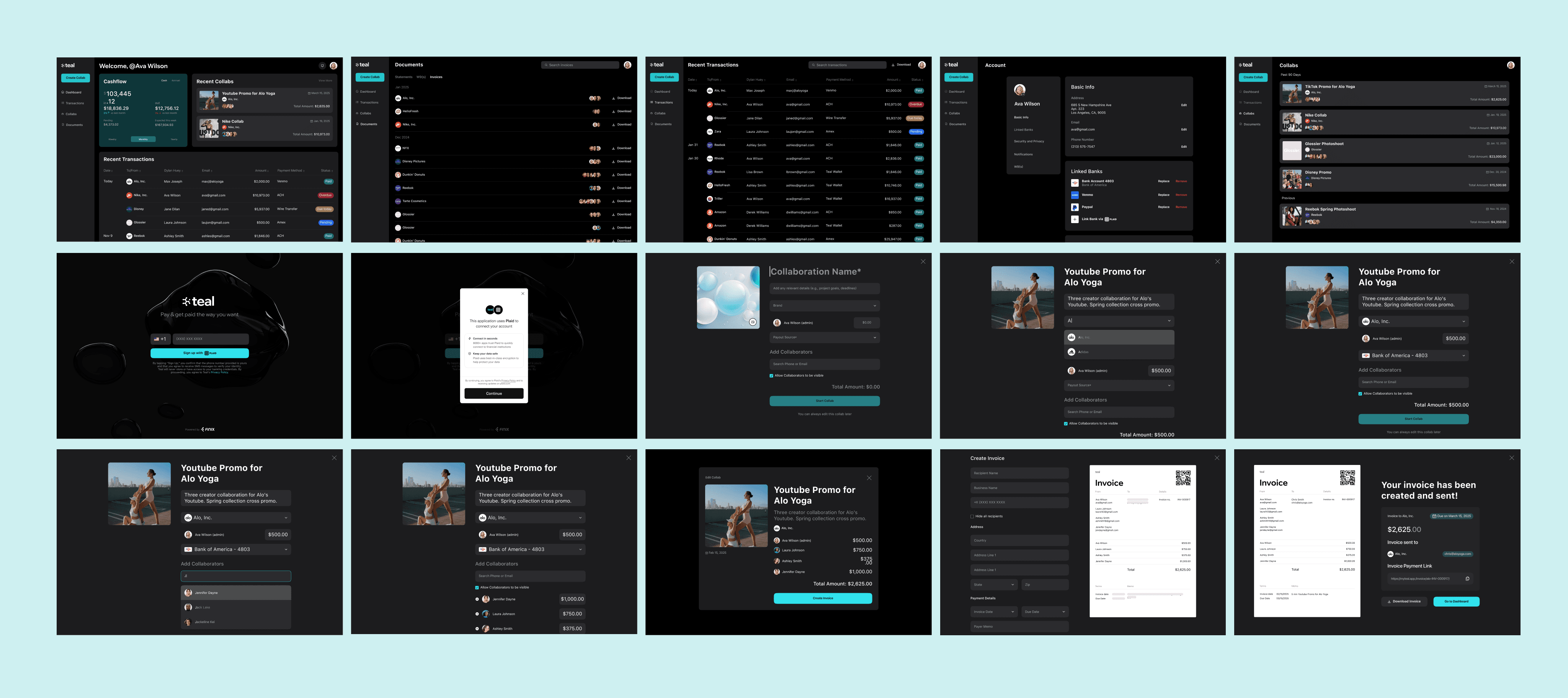
The web product was designed for agencies and managers who needed a ledger view tracking multiple collabs, multiple creators, multiple brands across time.
Outcome
Teal was a 0-to-1 concept built on real research, real pain, and real market data:
$34B global influencer marketing spend in 2024 the market was proven
$104B TAM across the creator economy with 50M active creators
$3B SOM targeting creators who collaborate our primary user
150 creators waitlisted before product launch
No competitor had all six capabilities: creator focus, collaborative payouts, global rails, real-time payments, multi-user splits, and stablecoin support
The project proved something more personal too: that a fintech designer who understands payment infrastructure can see problems that pure consumer designers miss and build the solution, not just describe it.
What I’d do differently
Run structured usability testing on the payment link flow with brand-side users we designed from the creator perspective but the brand experience was equally critical
Build a lightweight prototype earlier to test the split setup flow the multi-user collab setup was the most complex interaction and deserved more iteration time
Define the fan monetization feature more concretely it was the most differentiated part of the product but remained the least designed